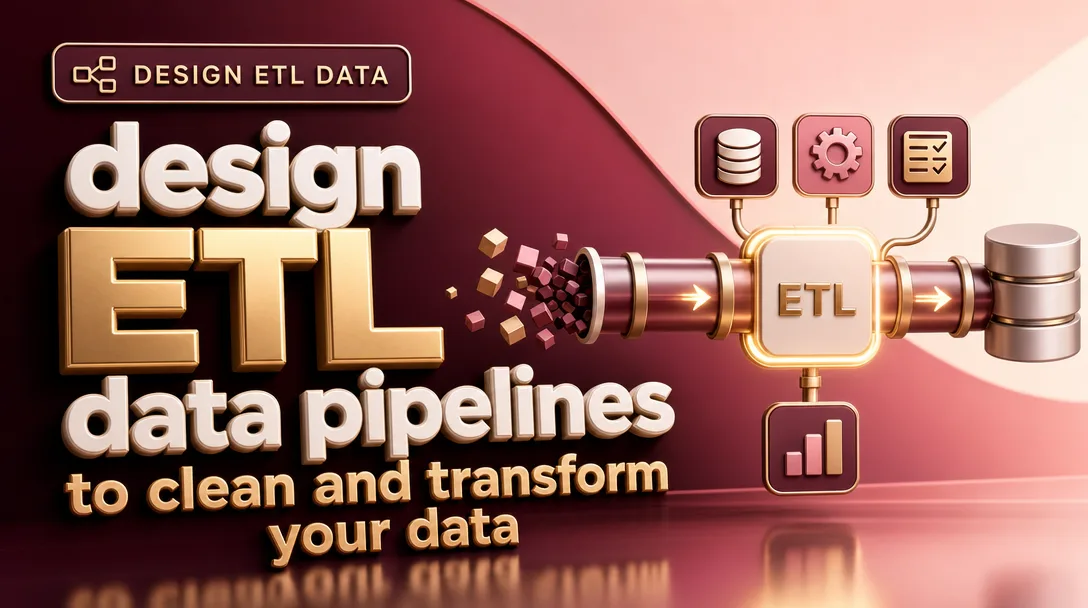
I will design ETL data pipelines to clean and transform your data
About this gig
I will design ETL data pipelines that clean, transform, and reliably move your data from messy sources into a structured, analysis-ready destination you can trust.
What you get
- A documented ETL (or ELT) pipeline that extracts from your sources, applies cleaning and transformation logic, and loads into your chosen warehouse, database, or file store.
- Source-to-target connectors for the systems you actually use: PostgreSQL, MySQL, SQL Server, REST and GraphQL APIs, CSV/Excel/JSON files, Google Sheets, S3/GCS buckets, and common SaaS exports (Stripe, Shopify, HubSpot, Salesforce, and similar).
- Data cleaning logic: deduplication, null and missing-value handling, type coercion, date and timezone normalization, currency and unit standardization, trimming and casing fixes, and rejection or quarantine of malformed rows.
- Transformation logic: joins across sources, aggregations, derived columns, lookups, pivoting/unpivoting, slowly-changing-dimension handling, and business rules translated into clear, version-controlled code.
- A clear target schema (staging plus a clean modeled layer) so downstream BI tools, dashboards, and analysts query consistent, well-named tables.
- Incremental loading where the source supports it (timestamps, change-data-capture, or watermark columns) so you process only new or changed records instead of full reloads.
- Data validation and quality checks built into the run: row-count reconciliation, schema/type assertions, uniqueness and referential checks, and freshness checks that flag stale data.
- Logging, error handling, and retry behavior so a single bad record or a flaky API call does not silently corrupt the result or kill the whole run.
- Orchestration and scheduling so the pipeline runs on a cadence you choose (hourly, daily, on file arrival, or on demand) with clear success/failure signals.
- A written runbook: how the pipeline works, how to run it, how to add a source, what each transformation does, and what to do when something fails.
- A handover walkthrough and source code in your repository so nothing is locked inside a black box.
Plans
| Feature | Basic | Standard | Premium |
|---|---|---|---|
| Sources connected | 1 source | Up to 3 sources | Multiple sources |
| Cleaning & transformation | Core cleaning + key transforms | Full cleaning + multi-source joins | Advanced modeling + business rules |
| Target destination | 1 destination | 1 destination | Multiple / layered destinations |
| Load strategy | Full refresh | Full or incremental | Incremental + CDC where supported |
| Data quality checks | Basic row/type checks | Validation suite | Full validation + freshness alerts |
| Orchestration & scheduling | Manual / simple schedule | Scheduled runs | Scheduled + retries + alerting |
| Documentation | Setup notes | Runbook | Runbook + architecture overview |
| Revisions | 1 | 2 | 3 |
Exact timelines depend on the number of sources, data volume, and how clean the raw data is. I will confirm a realistic delivery window with you before we begin.
How it works
- Discovery: you tell me your sources, where the data needs to land, how it will be used downstream, and how fresh it needs to be. I review samples of the real data.
- Scope and design: I map source fields to a target schema, define the cleaning and transformation rules, choose full-refresh vs. incremental, and agree on the destination and run cadence with you.
- Build: I develop the extract, clean, transform, and load steps with version control, sensible naming, and modular transformations that are easy to extend.
- Validation: I run the pipeline against real data, reconcile row counts, check types and constraints, and resolve edge cases like nulls, duplicates, and bad encodings.
- Orchestration: I schedule the pipeline, wire up logging and error handling, and configure failure notifications so you know immediately if a run breaks.
- Handover: I deliver the code, the runbook, and a walkthrough so you (or your team) can operate, monitor, and extend the pipeline confidently.
Why choose this
I focus on pipelines that hold up in production, not one-off scripts that break the first time a column name changes or an API returns an empty response. That means defensive cleaning, explicit validation, idempotent loads you can safely re-run, and documentation that lets someone other than me maintain the system. I write readable, version-controlled transformation logic instead of fragile spreadsheet macros or unrepeatable manual steps. You get a pipeline that is honest about its data quality: when something is wrong with a row, it is logged or quarantined rather than silently dropped. And because everything is delivered into your environment with full source code, you are never dependent on me to keep it running.
Who it's for / use cases
- Startups and small teams who have data scattered across a database, a few APIs, and a pile of spreadsheets, and need it consolidated into one clean source of truth.
- Analytics and BI teams who need reliable, well-modeled tables feeding their dashboards instead of brittle manual exports.
- E-commerce and SaaS businesses combining payments, orders, marketing, and CRM data for reporting on revenue, retention, or attribution.
- Companies migrating data between systems who need cleaning and reshaping along the way, not just a raw copy.
- Anyone drowning in repetitive manual data prep who wants it automated, scheduled, and trustworthy.
FAQ
Q: ETL or ELT, which do you build? Both. If your destination is a modern warehouse, ELT (load raw, then transform in-warehouse) is often cheaper and easier to debug. For smaller databases or constrained targets, classic ETL is the better fit. I recommend based on your stack and explain the trade-off.
Q: Which tools and languages do you use? Primarily Python (pandas, SQLAlchemy, and similar) and SQL, with orchestration via tools like Airflow, Prefect, Dagster, or simple cron, depending on scale. I match the tooling to your environment rather than forcing a heavyweight stack you do not need.
Q: Can you work with my messy, inconsistent data? Yes, that is the core of the job. Inconsistent dates, mixed encodings, duplicate records, free-text fields, and partial nulls are exactly what the cleaning layer is designed to handle. I will flag anything that needs a business decision rather than guessing.
Q: Will the pipeline run automatically? Yes. I set up scheduling on the cadence you choose and add retries and failure alerts so it runs hands-off, and you are notified the moment a run fails.
Q: How do you handle large data volumes? Through incremental loading, batching, chunked processing, and pushing heavy transformations down to the database or warehouse where possible. For very large datasets I will discuss the volume up front so the design fits.
Q: Do I keep the code and own the result? Absolutely. All source code, configuration, and documentation are delivered into your repository and environment. There is no black box and no lock-in.
Q: How do you keep my data secure? I work with credentials you provide through secure means, follow least-privilege access, never store data beyond what is needed for development and testing, and can sign an NDA on request.
Q: What do you need from me to start? Access to (or representative samples of) your sources, a description of the destination and how the data will be used, and a point of contact for business-rule questions. The more context you share early, the smoother and faster the build.
Reviews★0(0)
No reviews yet — be the first after your purchase.