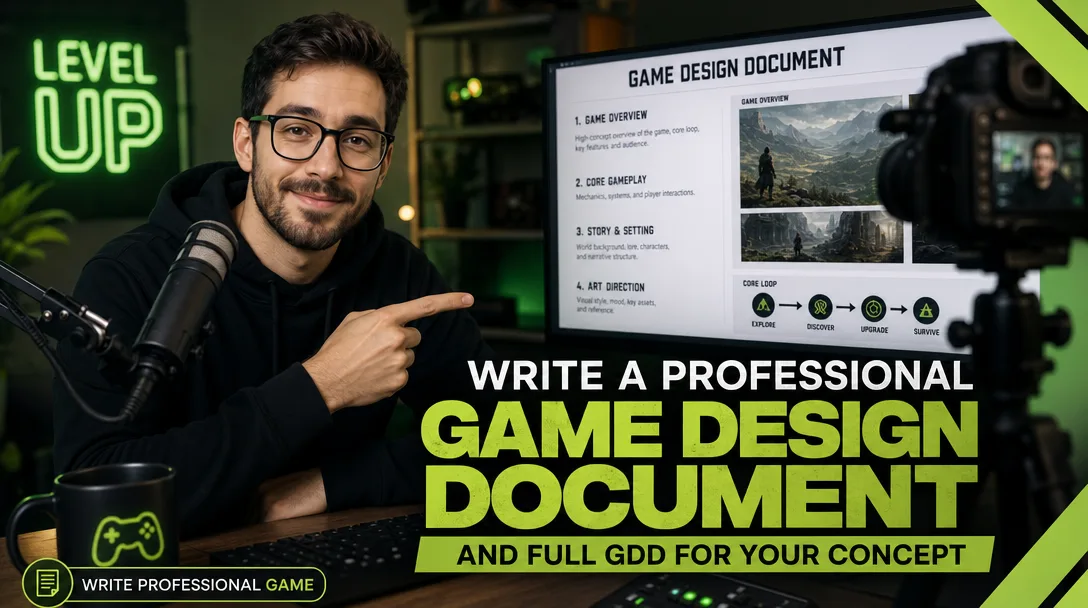
I will write a professional game design document and full GDD for your concept
About this gig
I will turn your game concept into a professional, studio-ready Game Design Document that your team, publishers, and investors can actually build and fund from.
A loose idea, a Discord brain-dump, or a half-finished pitch deck is not enough to align a team or convince a publisher. I write the structured, comprehensive GDD that bridges the gap between "wouldn't it be cool if" and an actual production plan. You bring the vision; I shape it into clear pillars, systems, loops, and specifications that artists, programmers, and designers can read and immediately understand what to make.
What you get
- A complete Game Design Document delivered as an editable file (Google Doc or Word/.docx) plus a clean PDF export, organized with a clickable table of contents and consistent heading structure.
- A sharp high-concept / elevator pitch section: genre, platform(s), target audience, unique selling points, and a one-paragraph hook you can reuse in pitches and store pages.
- Core design pillars (3-5) that act as the decision-making compass for every feature and cut.
- A documented core gameplay loop and broader session/meta loops, written so they're testable, not just descriptive.
- Mechanics and systems specifications: player verbs, controls, progression, economy/resources, win-loss conditions, and how systems feed each other.
- Narrative and world sections as your concept requires: premise, setting, tone, main characters, and how story is delivered through gameplay.
- Level / content structure: world or level breakdown, pacing curve, difficulty ramp, and example flow for a representative level or encounter.
- UI/UX and game flow: screen flow (main menu to gameplay to results), HUD elements, and key player-facing feedback.
- Art and audio direction notes: visual style references, mood, and audio intent written to brief a creative team (not final art assets).
- A scope, platform, and feature-priority section using MoSCoW (Must / Should / Could / Won't) so your team knows the MVP versus the wishlist.
- A risk and open-questions appendix flagging the design decisions you still need to make.
Plans
| Feature | Basic | Standard | Premium |
|---|---|---|---|
| Document type | Concept / mini-design doc | Full GDD | Full GDD + pitch-ready |
| Approx. length | Lean, focused | Comprehensive | Comprehensive + extended |
| High-concept & pillars | Yes | Yes | Yes |
| Core loop & mechanics | Core loop + key mechanics | Full systems & economy | Full systems & economy |
| Narrative & world | Brief | Detailed | Detailed |
| Level/content structure | Overview | Detailed + sample level | Detailed + sample level |
| UI/UX flow | Summary | Yes | Yes |
| Art & audio direction notes | Light | Yes | Yes |
| Scope & MoSCoW prioritization | — | Yes | Yes |
| One-page pitch / exec summary | — | — | Yes |
| Revision rounds | 1 | 2 | 3 |
| Source editable file + PDF | Yes | Yes | Yes |
How it works
- You order and share your concept. Send whatever you have: notes, a pitch deck, voice memos, reference games, mood boards, or just a paragraph. More raw material means a richer document.
- Discovery brief. I send a short questionnaire to lock down genre, platform, audience, tone, scope, and your must-have features. We resolve ambiguities here so the draft hits the mark.
- Outline approval. For Standard and Premium, I send a structured outline (section list) for your sign-off before writing, so the document covers exactly what matters to you.
- First draft. I write the full GDD, organizing your vision into pillars, loops, systems, and specs with consistent terminology throughout.
- Revision rounds. You review and leave comments; I refine wording, fill gaps, and adjust scope per your plan's included rounds.
- Final handoff. You receive the editable source file plus a polished PDF, ready to share with your team, collaborators, or potential publishers.
Why choose this
I write GDDs the way working studios actually use them: as living, navigable reference documents, not walls of unbroken text. The structure follows recognizable industry conventions (pillars, core loop, systems, scope) so anyone you hand it to feels at home immediately. I prioritize clarity and internal consistency, define terms once and use them everywhere, and I keep scope honest, flagging where ambition outruns a realistic MVP instead of quietly hiding it. You get an editable file, so the document keeps living and growing after delivery rather than freezing the moment I'm done.
Who it's for / use cases
- Indie developers and solo creators who need to organize a sprawling idea before writing a line of code.
- Small studios aligning artists, programmers, and designers around one shared source of truth.
- Founders and pitch-stage teams preparing to approach publishers, investors, or platform partners.
- Game jam or student teams turning a winning prototype into a fundable, expandable plan.
- Hobbyists who want a serious, professional document to anchor a passion project.
- Marketing or porting teams who inherited a game and need its design captured in writing.
FAQ
Q: What exactly is a GDD and do I really need one? A Game Design Document is the central reference that describes what your game is and how it works, from the core loop to systems, content, and scope. It's how you keep a team aligned and how you show a publisher you've thought the project through.
Q: I only have a rough idea. Is that enough to start? Yes. A paragraph and a few reference games are enough to begin. The discovery questionnaire is built to pull the rest of the vision out of your head and onto the page.
Q: Will you design the game for me, or document what I already have? Primarily I document and structure your vision, sharpening it as I go. I'll suggest improvements, flag inconsistencies, and propose options for open questions, but the creative direction stays yours.
Q: What format will I receive? An editable Google Doc or Word .docx, plus a clean PDF export. Both include a structured table of contents so the document is easy to navigate and update.
Q: Can you write a GDD for any genre or platform? Yes, across PC, console, mobile, and web, and across genres from puzzle and platformer to RPG, strategy, roguelike, and multiplayer. Share your references and I'll match the document depth to your genre's needs.
Q: Do you create art, code, or a playable prototype? No. This service delivers a written design document with art and audio direction notes to brief your creative team. It does not include final art assets, programming, or a build.
Q: How do revisions work? Each plan includes a set number of revision rounds. You leave comments on the draft and I refine wording, fill gaps, and adjust scope. Outline approval on Standard and Premium keeps revisions focused on polish rather than rewrites.
Q: Is my concept kept confidential? Yes. Your idea is yours. I'm happy to work under an NDA on request, and I don't share or reuse your concept.
Reviews★0(0)
No reviews yet — be the first after your purchase.