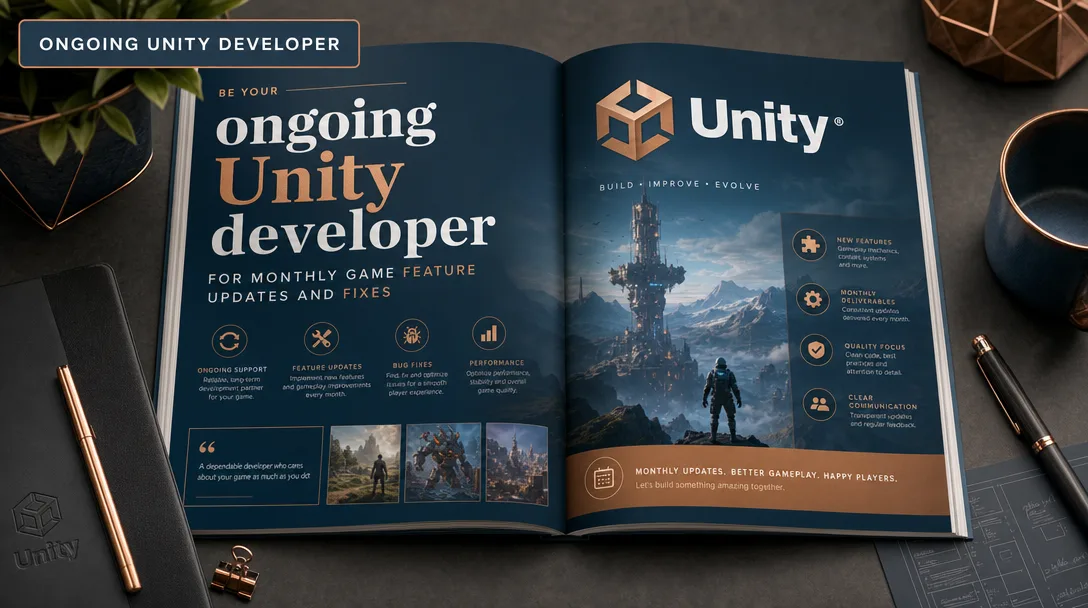
I will be your ongoing Unity developer for monthly game feature updates and fixes
About this gig
I will be your ongoing Unity developer for monthly game feature updates and fixes, shipping new content and squashing bugs on a steady, predictable cadence so your game keeps improving.
If you have a live Unity game (or one in active development) and you are tired of one-off contractors who disappear after the build compiles, this retainer keeps a single experienced developer attached to your project month after month.
What you get
A monthly retainer is about momentum: instead of scoping a fresh contract every time you want a new feature or a crash fixed, you get a dependable Unity developer working through your backlog in priority order. Concretely, each month includes:
- Feature development — new gameplay mechanics, UI screens, menus, settings panels, save/load systems, inventory, progression, difficulty curves, and similar additions built to fit your existing codebase and art style.
- Bug fixing — reproducible crashes, null reference exceptions, physics glitches, broken UI states, save corruption, input edge cases, and the "it only happens on some devices" class of problems.
- Live-ops content updates — adding levels, items, enemies, cosmetics, events, or balance tweaks using the data-driven systems you already have (or that I set up for you).
- Performance work — frame-rate profiling, draw-call reduction, garbage-collection spikes, memory leaks, load-time improvements, and platform-specific optimization.
- Build & release support — producing builds for your target platforms (PC, WebGL, Android, iOS, or standalone), updating settings, and helping push to your store/distribution channel.
- Third-party & SDK integration — ads, analytics, in-app purchases, leaderboards, cloud save, authentication, and similar plug-ins wired in correctly and tested.
- Clean, commented commits — every change pushed to your Git repository (GitHub, GitLab, Bitbucket, or self-hosted) with readable messages so you always know what changed and can roll back if needed.
- A short written summary at the end of each cycle — what shipped, what is in progress, and what I recommend tackling next.
I work inside your project. I match your folder structure, naming conventions, and architecture rather than imposing a rewrite, so the codebase stays coherent as it grows.
Plans
Plans differ by how much work fits into a monthly cycle and how fast turnaround is. Pick the tier that matches your pace; you can move up or down between months as your roadmap changes.
| Feature | Basic | Standard | Premium |
|---|---|---|---|
| Monthly scope | Light backlog — small features & priority bug fixes | Steady backlog — features + fixes + content updates | Heavy backlog — larger features, live-ops, optimization |
| Active development hours per cycle | Lower allocation | Mid allocation | Highest allocation |
| Bug-fix priority | Standard queue | Prioritized | Front of queue / fast-track |
| New features per cycle | Small / focused | Multiple | Multiple + complex systems |
| Performance & profiling pass | On request | Included periodically | Included every cycle |
| Build delivery | One platform | Multiple platforms | Multiple platforms + release help |
| Progress reporting | End-of-cycle summary | Summary + mid-cycle check-in | Summary + check-ins + roadmap input |
| Async communication | Email/message | Priority messaging | Priority messaging + scheduled calls |
| Revisions on delivered work | Included | Included | Included |
Every tier includes source-controlled commits and an honest account of what was and was not finished. No tier includes a price here; we agree on the retainer that matches the scope before any cycle starts.
How it works
- Intro & project handoff. You share your Unity project (repository access or a zipped project), tell me the Unity version, target platforms, and where the game stands. I confirm I can open, build, and run it before anything else.
- Backlog setup. We list the features, fixes, and improvements you want, and order them by priority. This becomes the shared backlog I pull from each month — a living list, not a frozen spec.
- Cycle kickoff. At the start of each monthly cycle we confirm what fits in that cycle's scope and what gets deferred. You always know what you are getting before work begins.
- Development. I work through the agreed items, committing in small, reviewable chunks. I flag blockers or risky changes early rather than surprising you at the end.
- Testing & build. I test on the target platform(s), fix what I find, and deliver a runnable build plus the updated source.
- Review & wrap-up. You review, request any revisions on the delivered work, and I send the end-of-cycle summary with recommendations for next month.
- Repeat. The retainer renews, the backlog rolls forward, and your game keeps moving.
Why choose this
You get continuity. The same developer who built last month's feature fixes this month's bug, so there is no re-learning your codebase, no context lost between contractors, and no "who wrote this and why" archaeology. Because the relationship is ongoing, I have a real incentive to keep your code maintainable rather than to ship fast and vanish.
You also get honesty about scope. If a request is bigger than a single cycle, I will tell you up front and propose how to split it, instead of overpromising and under-delivering. If something is not worth doing — a "feature" that will hurt performance or confuse players — I will say so and suggest an alternative.
And you get predictability. A monthly cadence means budgeting is simple, your roadmap actually moves, and you are not negotiating a new contract every time a player reports a crash.
Who it's for / use cases
- Solo developers and small studios who can design and create art but want a dependable engineer to handle the heavier Unity programming.
- Live games that need a steady stream of content updates, balance patches, and bug fixes to keep players engaged.
- Founders and non-technical owners who commissioned a game and now need someone reliable to maintain and extend it.
- Teams between hires who need senior Unity capacity without onboarding a full-time employee.
- Game jam or prototype projects that found an audience and now need to be hardened into something stable and shippable.
FAQ
Q: Which Unity versions do you work with? I work across modern Unity LTS and recent releases. Tell me your exact version at handoff and I will match it — I do not force an engine upgrade unless you specifically want one, since upgrades can introduce their own risks.
Q: Can you join a project I did not start? Yes. Inheriting existing codebases is the norm for this service. I spend the first part of the engagement reading the project, getting it to build, and mapping how it is structured before I change anything.
Q: What platforms can you build for? PC (Windows/Mac/Linux), WebGL, Android, and iOS are all in scope. Console work depends on you holding the required developer accounts and SDK access; tell me your target and I will confirm what is feasible.
Q: How do you handle source control and avoid breaking my game? I commit in small, labeled chunks to your Git repository so every change is traceable and reversible. Risky changes go on a branch for your review before they touch your main line.
Q: What if a bug cannot be reproduced? I will tell you honestly. I will add logging or diagnostics to capture it in the wild rather than guessing, and we will treat the investigation as part of the backlog. I will not silently bill a "fix" for something I could not actually confirm.
Q: Can I change the backlog mid-month? Yes, within the cycle's scope. Priorities shift in game development, and the backlog is meant to flex. If a new item is urgent we re-order; if it is large, we plan it into the next cycle.
Q: Do you also design game mechanics, or only implement? I will happily advise on implementation trade-offs, feasibility, and performance implications of a design. Core creative direction stays with you — I am your developer, not a substitute for your vision.
Q: What happens if I want to pause or stop? The retainer is monthly, so you are never locked in long-term. If you pause, I hand off cleanly: everything is already in your repository, with the latest summary documenting exactly where things stand.
Reviews★0(0)
No reviews yet — be the first after your purchase.