I will write a grant proposal for your nonprofit or small business
About this gig
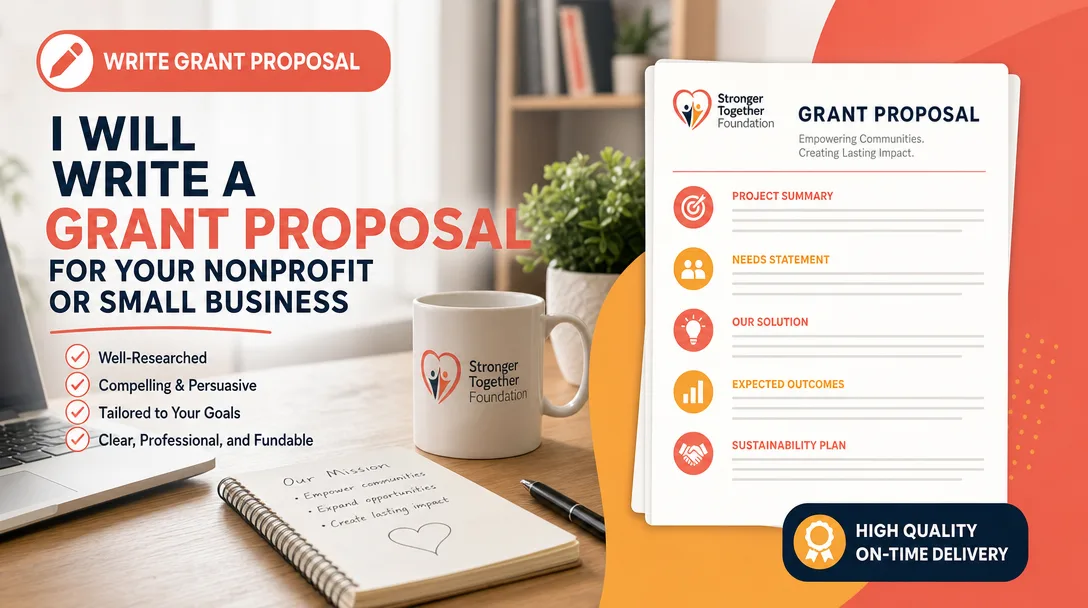
I will write a compelling, fundable grant proposal tailored to your nonprofit or small business, matched precisely to your target funder's priorities, format, and evaluation criteria.
What you get
A grant proposal is not a generic document you can copy and paste from funder to funder. Reviewers reject applications that ignore their stated priorities, miss word limits, or fail to connect a clear need to a measurable outcome. I write each proposal from the ground up for one specific opportunity, so every section answers the questions that funder actually asks.
- A complete, ready-to-submit narrative written to your chosen grant opportunity (foundation, corporate, or government), aligned to its guidelines and scoring rubric
- A sharp statement of need / problem statement backed by the data and context you provide, framed to resonate with the funder's mission
- Clear, specific goals, objectives, and a methodology or program plan that shows exactly how the money will be used
- A logic model or outcomes framework with measurable indicators (outputs vs. outcomes) and an evaluation approach reviewers can trust
- An organizational background / capacity section that positions you as a credible, low-risk grantee
- A sustainability and impact narrative explaining what happens after the grant period ends
- A draft project budget narrative that justifies line items and ties spending to activities (I write the narrative; you supply the actual figures)
- An executive summary or cover letter / letter of inquiry (LOI) when the opportunity calls for one
- Clean formatting that respects character counts, page limits, font and margin rules, and required headings
- Plain-language polish: active voice, no jargon, no filler, tight enough to keep a tired reviewer reading
You receive the proposal in an editable document (Google Docs or Word) so you can submit it through any portal or PDF it yourself.
Plans
| Feature | Basic | Standard | Premium |
|---|---|---|---|
| Funder opportunities covered | 1 | 1 | Up to 2 |
| Statement of need / problem statement | Yes | Yes | Yes |
| Goals, objectives & program plan | Yes | Yes | Yes |
| Logic model / outcomes framework | Summary | Full | Full |
| Budget narrative | — | Yes | Yes |
| Executive summary or LOI | — | Yes | Yes |
| Cover letter | — | — | Yes |
| Funder-fit research & guideline mapping | Light | Standard | In-depth |
| Revision rounds | 1 | 2 | 3 |
| Tailoring for a second funder | — | — | Yes |
| Delivery format | Editable doc | Editable doc | Editable doc + submission checklist |
Every plan is built around your real organization and a real, named opportunity. The tiers differ in depth, supporting sections, and how many funders the work is adapted for, never in the quality of the core writing.
How it works
- You place your order and share your materials. Send me your organization's basics (mission, history, programs), the specific grant opportunity or RFP you're targeting, and any data, prior proposals, or strategic plans you have. A link to the funder's guidelines is ideal.
- I review the funder and the fit. I read the opportunity's guidelines, priorities, eligibility rules, and scoring criteria, then flag any gaps or mismatches before I start writing. If something looks like a poor fit, I'll tell you honestly.
- We align on scope. I'll confirm the project you're seeking funding for, the requested amount range (which you set), the key outcomes, and the deadline so the proposal is built on accurate assumptions.
- I write the first draft. You receive a complete, structured narrative organized to the funder's required sections, with placeholders clearly marked wherever I need a number or detail only you can provide.
- You review and we revise. You send feedback and corrections; I revise within the number of rounds your plan includes, tightening the argument and fixing anything that doesn't match your organization.
- You submit. I deliver the final editable file plus, on Premium, a submission checklist so nothing required gets missed in the funder's portal.
Why choose this
I write to the rubric, not to a template. The first thing I do is map the funder's stated evaluation criteria to the sections of your proposal, so reviewers can find what they're scoring exactly where they expect it. That single habit is what separates funded proposals from rejected ones.
I also write honestly. I won't invent statistics, inflate your track record, or promise outcomes your program can't realistically deliver, because experienced reviewers spot exaggeration immediately and it sinks otherwise strong applications. Instead, I make the strongest truthful case for the work you actually do. You get clear, persuasive prose, a logical line from need to method to measurable result, and formatting that respects every rule the funder set.
Who it's for / use cases
- Nonprofits applying to private or community foundations for program, capacity, or general operating support
- Small businesses and startups pursuing government grants, economic development funds, or innovation programs
- Grassroots and newly formed organizations submitting their first proposal and unsure how to structure it
- Established organizations that have the program expertise but no in-house grant writer or bandwidth before a deadline
- Teams that need a letter of inquiry (LOI) before a foundation will invite a full proposal
- Anyone who has been declined and wants a sharper, better-aligned rewrite for the next cycle
FAQ
Q: Can you guarantee I'll win the grant? No, and you should be skeptical of anyone who does. Funding decisions depend on the funder's budget, competition, and priorities that are outside any writer's control. What I guarantee is a clear, compliant, persuasive proposal that gives you the strongest honest shot at being funded.
Q: Do I need to have a funder picked already? For the best results, yes. A proposal written to a specific opportunity always outperforms a generic one. If you're still deciding, share a shortlist and I'll help you target the best-fit option as part of the funder-fit work.
Q: Who provides the budget numbers? You do. I write the budget narrative that justifies and explains your figures and ties them to activities, but the actual dollar amounts, salaries, and line items must come from you so they're accurate and defensible.
Q: What do you need from me to start? Your organization's mission and background, a description of the project you want funded, the target opportunity or RFP, the deadline, and any supporting data or past proposals. The more context you share, the stronger and faster the draft.
Q: How do revisions work? After the first draft, you send consolidated feedback and I revise within the number of rounds your plan includes. Revisions cover refining the narrative, correcting details, and tightening to the guidelines, not rewriting for a completely different project or funder.
Q: Can you submit the application for me? I deliver a submission-ready editable file and, on Premium, a checklist, but you keep control of the final submission through the funder's portal. This keeps your account, credentials, and certifications in your hands where they belong.
Q: Can you handle government or federal-style proposals? Yes. I can write to structured RFP formats with required sections, compliance language, and evaluation factors. Highly specialized federal mechanisms may need extra detail from you on technical or regulatory requirements, which we'll confirm up front.
Q: What if my project isn't a good fit for the funder I chose? I'll tell you before writing. It's better to redirect to a stronger-fit opportunity than to spend a draft on one your project doesn't qualify for. Honest guidance up front saves you a wasted cycle.
Reviews★0(0)
No reviews yet — be the first after your purchase.