I will build immersive Unreal Engine 5 gameplay systems and Blueprint mechanics
About this gig
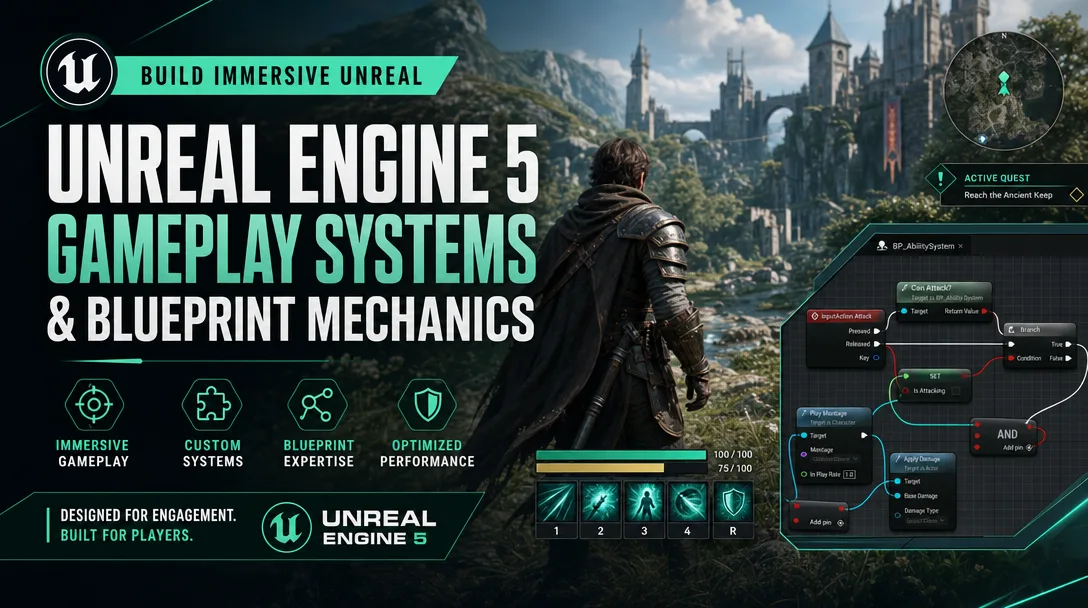
I will build immersive Unreal Engine 5 gameplay systems and Blueprint mechanics that feel responsive, ship-ready, and tuned to how your players actually move and fight.
If you have a prototype that stalls when you try to add real mechanics, or a clean idea that needs a working vertical slice, I turn design intent into running UE5 systems. I work primarily in Blueprints, drop into C++ when a system needs the performance or reusability, and hand back something your team can read, extend, and debug long after delivery.
What you get
- Working gameplay systems built in Unreal Engine 5 (5.3 / 5.4 / 5.5), delivered as Blueprints and, where it matters, C++ classes you own outright.
- Core mechanics implemented to spec: character movement and traversal (sprint, crouch, mantle, climb, dash, double-jump), interaction systems, inventory and pickups, weapons and combat (melee or ranged), health/damage/death, and stamina or resource meters.
- Ability and state logic using the Gameplay Ability System (GAS) when your design calls for abilities, cooldowns, and stacking effects — or a lightweight custom state machine when GAS would be overkill.
- Enemy and NPC behavior via Behavior Trees, Blackboards, EQS, and the navigation mesh: patrol, chase, attack, flee, and aggro logic tuned to feel deliberate rather than robotic.
- Interaction and trigger systems: doors, levers, pressure plates, collectibles, checkpoints, and event-driven sequences wired with interfaces and dispatchers, not spaghetti casting.
- Clean UMG UI hookups for the systems I build — health bars, ammo counts, prompts, cooldown indicators — bound to the underlying data so they stay in sync.
- Save/load wiring for game state when in scope (SaveGame objects for progression, inventory, and settings).
- A short Loom walkthrough of the systems, plus inline comments and a written README so your team understands the architecture and can extend it.
- A bug-fix window after delivery so anything that surfaces in your build gets resolved.
Plans
| Basic | Standard | Premium | |
|---|---|---|---|
| Scope | One focused mechanic or system | A connected set of core systems | A full gameplay vertical slice |
| Examples | Interaction system, single weapon, sprint/crouch movement | Movement + combat + health/damage + basic enemy AI | Movement, combat, ability system, enemy AI, inventory, UI, save/load |
| Blueprint implementation | Yes | Yes | Yes |
| C++ where beneficial | On request | Yes | Yes |
| Enemy AI (Behavior Tree) | — | Basic | Advanced (EQS, multiple states) |
| Gameplay Ability System | — | Optional | Yes |
| UMG UI hookup | — | Core HUD elements | Full system UI |
| Save/load wiring | — | — | Yes |
| Commented code + README | Yes | Yes | Yes |
| Video walkthrough | Yes | Yes | Yes |
| Revisions | 1 | 2 | 3 |
| Bug-fix window | Yes | Yes | Yes |
How it works
- Brief and scope. You send your design notes, references, and current project (or a description if you're starting fresh). I ask the questions that actually matter — target platform, perspective, whether multiplayer is in play, and which systems are must-have versus nice-to-have.
- Plan and confirm. I write back a concrete breakdown: the systems I'll build, the approach (pure Blueprint, C++, or GAS), the architecture, and any assets or plugins you'll need to provide. We lock scope before work starts so there are no surprises.
- Build in milestones. For Standard and Premium, I deliver in checkpoints rather than one big drop, so you see movement before combat, combat before AI, and can course-correct early.
- Test and tune. I playtest each system, profile for hitches, and tune the feel — input responsiveness, animation timing, hit feedback — because a mechanic that works on paper still has to feel good in hand.
- Handoff. You receive the project (or migration-ready Blueprint/C++ files), the README, and a recorded walkthrough. I confirm everything compiles and runs cleanly in your engine version.
- Support. During the bug-fix window I resolve issues that come up as you integrate, and I'm available for follow-on work if you want to keep building.
Why choose this
I build systems the way a teammate would, not a one-off contractor dropping a black box. That means readable Blueprint graphs with reroute nodes and comments, interface-driven communication instead of fragile casting, and data-driven setups (Data Tables, curves, configurable variables) so your designers can tune values without reopening logic. I default to Blueprints because they're fast to iterate and easy for your team to maintain, and I reach for C++ only when a system genuinely benefits from it — performance-critical loops, base classes you'll subclass heavily, or logic that belongs in source control as text. Either way, you own everything I deliver.
Who it's for / use cases
- Solo developers and small studios with a prototype that needs real, dependable mechanics to become a vertical slice.
- Designers and creative leads who can describe the experience they want but need an engineer to make it run.
- Teams under deadline who need an extra pair of hands to build a self-contained system — an inventory, an ability set, an enemy archetype — without derailing their main pipeline.
- Game jam and demo builds that need polished core loops fast for a pitch, festival submission, or playable demo.
- Educators and content creators wanting a clean, well-commented reference implementation of a specific UE5 system.
Common requests: third-person action combat, first-person shooter mechanics, survival/crafting loops, puzzle-interaction systems, soulslike stamina-and-lock-on combat, and twin-stick or top-down ability systems.
FAQ
Q: Do you work in Blueprints or C++? Both. I default to Blueprints for speed and maintainability and use C++ where it earns its place — performance-heavy systems, reusable base classes, or logic you want under version control as text. I'll recommend the right mix for your project and you keep full ownership of all code.
Q: Which Unreal Engine versions do you support? UE5.3, 5.4, and 5.5. Tell me your exact version up front and I'll build and test against it so the project opens and compiles cleanly on your side.
Q: Can you work in my existing project? Yes. I can build directly in your project or deliver migration-ready Blueprint and C++ files you drop in. For an existing project, a quick look at your current setup helps me match your conventions.
Q: Do you handle multiplayer and replication? Replicated gameplay systems are in scope when we agree on it up front, since networked logic takes meaningful extra work. Mention it during scoping so I can plan the architecture for replication from the start rather than retrofitting it.
Q: Will the systems include art, animation, or sound? I build the systems and logic, and I wire up the assets you provide — animations, meshes, audio, and VFX. I don't create original art, but I'll integrate placeholder or marketplace assets so everything is testable and ready for your final content.
Q: How do you handle changes once we start? Each plan includes a set number of revisions within the agreed scope. If you want to expand scope mid-project — a new mechanic, an extra enemy type — we'll talk it through and adjust the plan rather than quietly cutting corners.
Q: What do you need from me to start? Your design notes or references, target platform and perspective, your engine version, and any assets the systems should use. The clearer the brief, the faster I can lock scope and start building.
Q: What if I find a bug after delivery? Every plan includes a post-delivery bug-fix window. If something I built misbehaves once you integrate it, send me a repro and I'll fix it. Issues caused by unrelated changes elsewhere in your project fall outside that window, but I'm always happy to quote follow-on work.
Reviews★0(0)
No reviews yet — be the first after your purchase.