I will engineer and optimize production prompt libraries with evals and versioning
About this gig
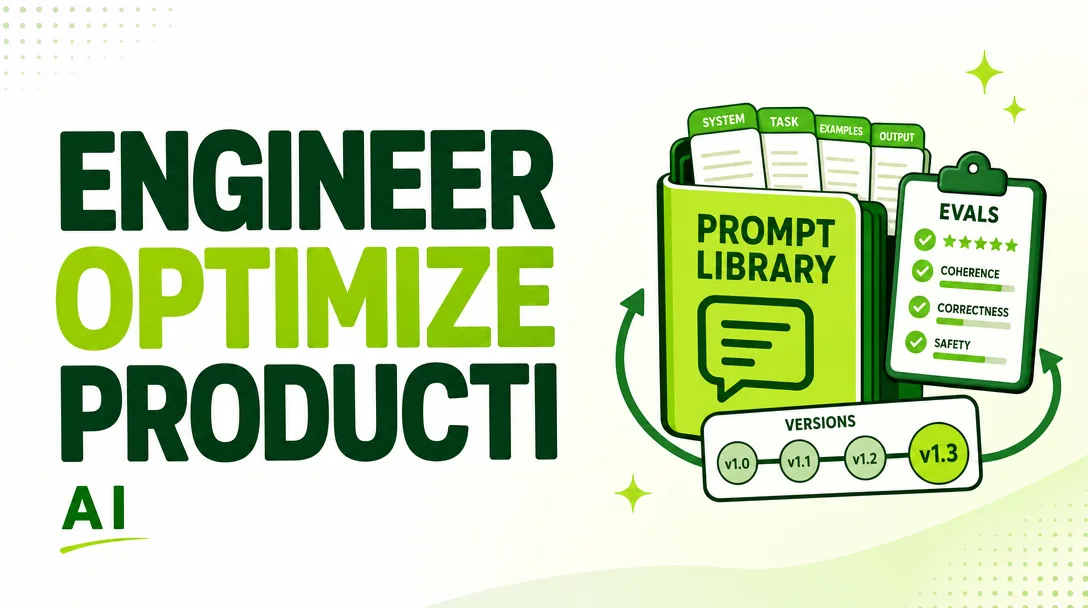
I will engineer and optimize production prompt libraries with evals, versioning, and regression guards so your LLM features ship reliably and stay reliable as you scale.
Most teams treat prompts as throwaway strings buried in code. I treat them as production assets: tested, versioned, measured, and owned. If your AI feature works in the demo but breaks in the wild, this is the gig that fixes the foundation.
What you get
- A structured prompt library organized by task, model, and use case — not a folder of copy-pasted text, but a maintainable catalog with clear naming, metadata, and ownership.
- Optimized prompts for each of your target tasks: rewritten for clarity, role framing, constraint specification, output formatting (JSON/schema-conformant where needed), and token efficiency. I cut wasted tokens without losing quality.
- An eval harness: a set of test cases (inputs + expected behavior + scoring criteria) that lets you objectively measure whether a prompt change made things better or worse. Scoring can be exact-match, schema validation, rubric-based LLM-as-judge, or a mix — chosen to fit each task.
- A versioning scheme so every prompt has a tracked history, a changelog, and the ability to roll back. Changes become reviewable diffs, not silent edits.
- Regression detection: a baseline of your current prompts' scores, so when you (or I) change a prompt, you immediately see what improved and what broke.
- Model-fit notes: guidance on which prompts work best on which model tier, and where a cheaper model is good enough versus where you genuinely need a frontier model.
- A handoff document explaining the structure, how to add new prompts, how to add eval cases, and how to read the results — so your team can run with it after I'm gone.
This is a hands-on delivery service. I do the engineering work directly against your real tasks and data (or representative samples you provide), not a generic template.
Plans
| Basic | Standard | Premium | |
|---|---|---|---|
| Prompts engineered/optimized | Up to 3 | Up to 10 | Up to 25 |
| Eval test cases | Lightweight set | Full per-prompt suite | Comprehensive + edge cases |
| Scoring methods | Exact / schema | + Rubric & LLM-judge | + Custom multi-metric |
| Versioning & changelog | Basic | Full history | Full + branching strategy |
| Regression baseline report | — | Included | Included + dashboards |
| Model-fit recommendations | — | Included | Included, per-prompt |
| Live walkthrough call | — | — | Included |
| Revision rounds | 1 | 2 | 3 |
| Handoff documentation | Short | Full | Full + team enablement |
All tiers deliver working, runnable artifacts you own outright. Pick the tier by how many prompts you need covered and how rigorous you want the evaluation layer.
How it works
- Intake. You share your current prompts (or describe the tasks if you're starting fresh), the model(s) you use, example inputs, and what "good output" means for each task. I send a short questionnaire to make this fast.
- Audit & baseline. I review your existing prompts, identify failure modes, and — where prompts already exist — run them against an initial eval set to establish a starting score. You see exactly where you stand before any changes.
- Engineering. I rewrite and optimize each prompt: tighter instructions, better role and constraint framing, robust output formatting, and few-shot examples where they earn their tokens. Each change is justified by eval results, not vibes.
- Eval build-out. I construct the test cases and scoring logic so every prompt has measurable pass/fail criteria. This is what separates real prompt engineering from guessing.
- Versioning setup. I put the library under a clear versioning scheme with a changelog so future edits are tracked and reversible.
- Review & iterate. I share results, you give feedback, and we run the included revision rounds to tune anything that needs it.
- Handoff. You receive the full library, eval harness, baseline/regression reports, and documentation, plus a walkthrough on Premium.
Why choose this
Anyone can rewrite a prompt to sound nicer. The hard part is knowing whether the new version is actually better — and proving it stays better after the next ten changes. My work is built around that proof. Every optimization is backed by an eval score, every change is versioned and reversible, and you leave with a system your team can maintain, not a one-off rewrite that rots in a week.
I focus on production reliability: schema-conformant outputs, predictable behavior across inputs, sensible model selection, and token costs that don't surprise you. I'm honest about scope — if a prompt is already near-optimal, I'll tell you and point the effort where it actually moves the needle.
Who it's for / use cases
- Startups shipping an LLM feature (chat, extraction, classification, summarization, agents) that needs to behave consistently for real users.
- Teams whose prompts have grown organically and are now an untracked, untestable mess.
- Product owners who keep getting "it works on my machine" prompt changes with no way to verify quality.
- Engineers who want an eval harness as a foundation so they can iterate on prompts with confidence.
- Agencies and consultancies that need a clean, versioned prompt deliverable to hand to a client.
Common tasks I optimize: structured data extraction, document and ticket classification, summarization with strict formatting, RAG answer generation, agent/tool-calling instructions, content rewriting, and customer-support response drafting.
FAQ
Q: Which models and providers do you support? I work across the major LLM providers and model tiers. Tell me which model(s) you use and I'll engineer and evaluate against those specifically, since prompts that win on one model don't always win on another.
Q: What do I need to provide? Your existing prompts (if any), the model you're using, a handful of real or representative example inputs, and a description of what good output looks like for each task. The more examples you share, the sharper the evals.
Q: Can you work without exposing sensitive data? Yes. Anonymized or synthetic samples that preserve the structure of your real inputs work fine for engineering and evals. We can scope what you share before anything is sent.
Q: How do you measure that a prompt actually improved? Through the eval harness: each prompt runs against a fixed test set with defined scoring (exact-match, schema validation, rubric, or LLM-as-judge). I compare the new version's score against the baseline so improvement is a number, not an opinion.
Q: What format are the deliverables in? Plain, portable files — prompts with metadata, the eval cases and scoring logic, version history and changelog, and the baseline/regression reports. Everything is framework-agnostic and yours to keep and modify.
Q: Do you set up automated evals in my CI pipeline? The core deliverable is a runnable eval harness. Wiring it into your specific CI/CD pipeline is available as an add-on — share your stack and I'll scope it.
Q: What if the optimized prompts don't beat my current ones? That's exactly what the baseline is for. If a prompt is already strong, the evals will show it, and I'll redirect effort to the prompts and edge cases where real gains exist. You always see the before-and-after numbers.
Q: Can you handle ongoing prompt maintenance after delivery? Yes. Many clients start with a library build and then keep me on for periodic optimization as new tasks and edge cases emerge. We can discuss an ongoing arrangement once the foundation is in place.
Reviews★0(0)
No reviews yet — be the first after your purchase.